






Back to all videos
The Capstone Journey: From Idea to Presentation and Beyond
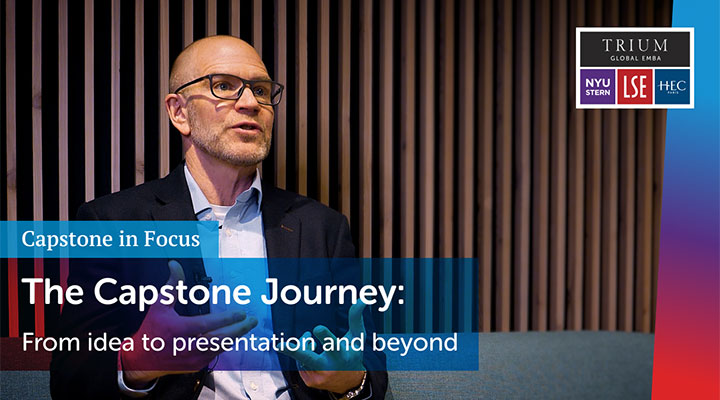
Learn about the Capstone Journey with a walkthrough of how the Capstone unfolds across the program, from the first two-minute idea pitch to the final presentation in front of faculty and alumni. Students can choose from three different project paths: a greenfield start-up, a social entrepreneurship venture, or an internal company project tackling a real strategic challenge.
In this video you’ll learn:
- The three types of Capstone projects: start-up ventures, social entrepreneurship, and internal company consulting projects.
- How the Capstone journey unfolds, from a two-minute pitch and team formation to final presentation and evaluation.
- How TRIUM students develop and refine a business idea, including value proposition, prospectus and full business plan.
- How feedback from TRIUM’s global alumni network and faculty helps shape projects and strengthens real-world decision-making.
Speaker:
Professor Matt Mulford, TRIUM Capstone Director
Full transcript
The TRIUM Capstone Project can be one of three types. One project they can do is a complete greenfield startup. So this is a business plan from the start for a profit organization. The second is they they can try some sort of social entrepreneurship. So in this case they aren’t necessarily doing something for profit. The requirement is that it has to be self-sustaining economically.
And the third thing they can do is an internal company project. So this is essentially that the TRIUM Capstone group becomes a kind of team of internal consultants that’s helping a company or an organization in some large strategic venture. Often it’s what country should we expand into? So maybe you’re very successful in France and you’re looking what should be our next country of operation, that sort of thing.
So the journey students will experience as part of capstone is they will start… everybody gets an opportunity to have a two minute pitch of an idea, and that launches the kind of marketplace of the ideas from that two minute pitch.
At an individual level, the students get together in groups of 4 to 6, so they have to sell their idea to other people. So in the second module, they do these individual pitches. They get to a self-formed group that’s finalized then by the third module, and then they have to put together a prospectus. So that’s the next big step. They have to come together with some sort of description of an idea that they could share with friends that didn’t know anything about the business. So the idea is they have to really hone down their value proposition, whatever this idea is, in a way that can be communicated. Then after that, in some ways the really hard work starts.
They start putting together a business plan. They look at competitive analysis, they look at strategy. Again, it’s allowing them to learn by doing so we have marketing courses, we have strategy courses, we have finance courses obviously. But the Capstone allows them to actually apply it to a case in a way and in a case for many of them, that’s really, really important because they’ve come up with it themselves.
Right after module three, we have them present to an alumni board. So TRIUM has more than a thousand alumni now. And so we have big spread of industry expertise. And so what we do is we put together panels of industry adjacent or in that same industry that the Capstone is a part of, and they give that group specific feedback based on their expertise within the same industry.
That’s super valuable because it stops them from going down blind alleys. Then by about the fifth module, what happens is that they kind of do a live test version of the presentation. This is the first time they reveal the kind of full project to their fellow students. And then we end up in module six, the final module where they present in front of a jury, formal jury, which will involve both academic members but also alumni.
The alumni at the final journey will be often people with VC background or entrepreneurial background. And they give then the feedback, there they get the grade, it counts for essentially a module worth of work and off they go. And like I said, for some people that’s the start of the journey for the Capstone Project.
They go on then to develop it into a business, etc., etc. and for a lot of people, that’s the end of the journey because it’s fulfilled that role of playing both the role of leadership development and also getting getting away to learn by doing, by applying it to a real case.