





Back to News index
MAY 2026
Class of 2027 – the journey so far
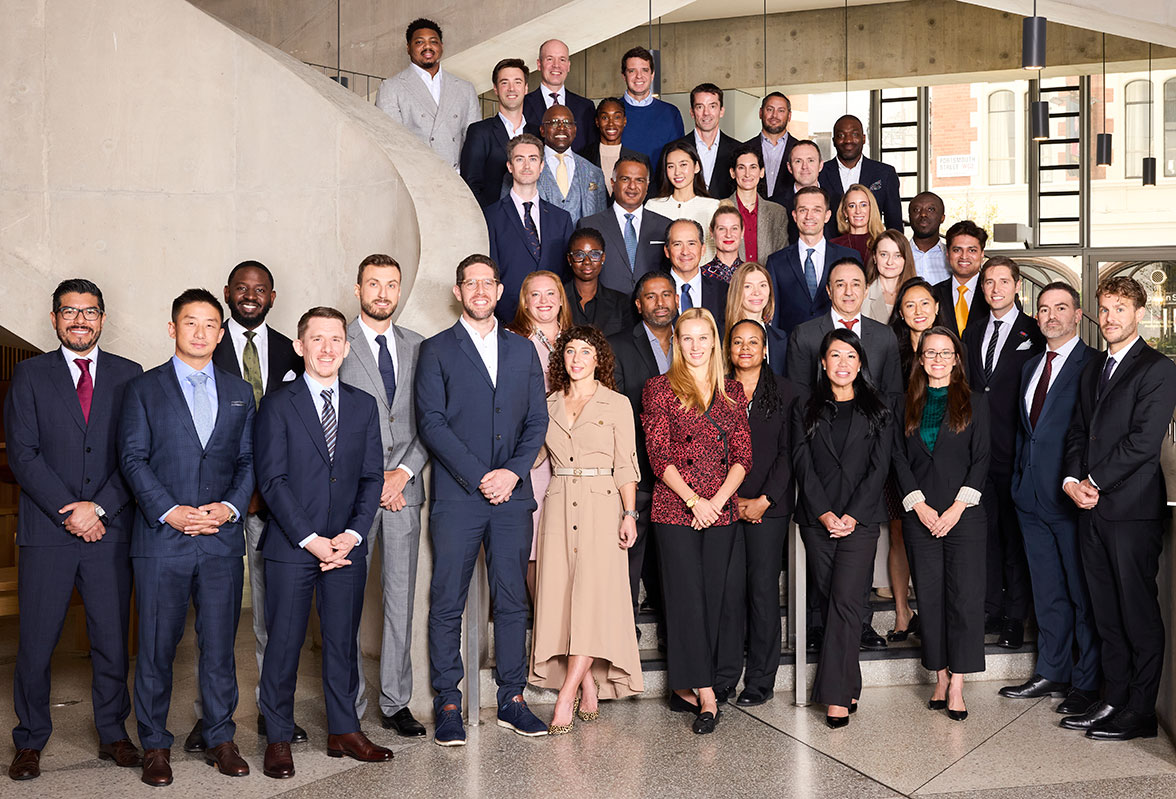
In September 2025, LSE opened its doors to the Class of 2027, bringing together senior leaders from across the globe. Different sectors, different contexts, but common ground in their aim to sharpen how they lead and decide through academic rigour and reflective peer-to-peer learning.
With 28 nationalities represented across 16 sectors, the cohort arrived ready to pressure test ideas and assumptions against a room of people carrying responsibility in very different settings.
The program began in traditional TRIUM fashion with a session designed to put leaders under pressure from the outset. Leadership expert and industry veteran Hervé Coyco (former President of Michelin Asia-Pacific operations) tasked the class to navigate a high-profile incident involving Michelin, unpacking the trade-offs and communications pressures that come with high-stakes calls under intense scrutiny. The session set the tone from day one, prompting the class to reflect on how they make decisions when time is limited, the situation is evolving, and every option carries consequences.
The London module, with its focus on geopolitics, is not the norm in Executive MBA education. Built on the strength of the LSE with its distinctive focus on understanding how economies, societies, and political systems interact, it starts from a simple idea: global political economy and business are closely intertwined, and political decisions can have direct consequences for markets and organisations. TRIUM Academic Dean Robert Falkner set the tone with a look at globalization, and what deglobalization can mean for business, with faculty building on how years of political decision-making have contributed to today’s fragmented environment. The discussions moved quickly from the shifting relationship between the US, China, and Russia to a moment of possibility for the EU, and what it might take for Europe to find a stronger collective voice.
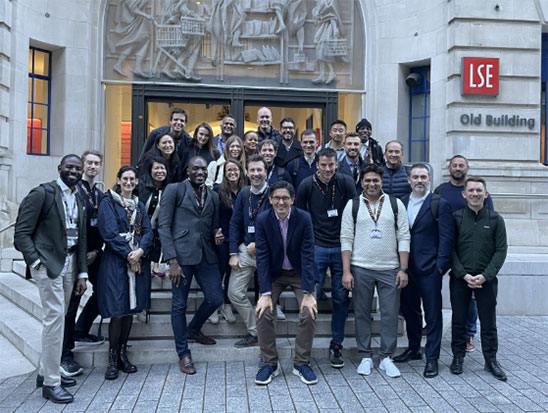
The class with TRIUM Academic Dean, Professor Robert Falkner
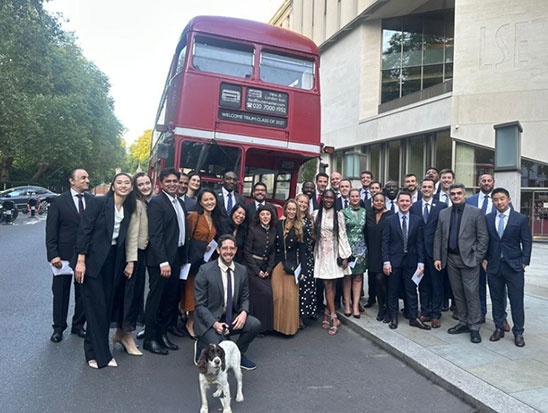
The class en route to the House of Lords
Being in London, surrounded by institutions that have shaped global policy and business, shifted my perspective. One conversation that stuck with me was around navigating global fragmentation not just as a risk, but as an opportunity to build more resilient, adaptive strategies. It changed how I think about leadership, which is about navigating complexity with clarity” – Rachelle.
Students left London with a clearer grounding in how political decisions change the environments organisations operate in, and how leaders can respond when rules, alliances, and markets are moving at once. The module closed, as TRIUM tradition demands, with a Routemaster bus ride through London followed by a formal dinner at the House of Lords. A fitting full stop to the first chapter, before New York and the finance and strategy module at NYU Stern.
New York in January 2026
After a strong market rally in 2025, the pull of Wall Street is palpable. A few blocks away, the cohort returned to NYU Stern School of Business, a pioneer in business education and innovation. Often described as a baptism of fire in the TRIUM journey, the finance-focused module does not shy away from the quantitative and analytical work senior leaders need. Advanced topics in valuation, data analytics, and risk were explored in depth alongside the limits of data when making significant strategic calls.
This is also where Capstone projects were launched. Students pitched early ideas to the class, turning ambition into a structured project that will be developed and challenged across the remaining modules, and in many cases taken into the real world.
For the first time in this journey, I had a platform to pitch my own venture in a safe, supportive environment with real, constructive feedback. It felt like a mini global stage and gave me meaningful practice for broader leadership aspirations.” – Kenisha
The teaching was led by experts in the field, including Sonia Marciano, and sessions with Aswath Damodaran, widely regarded as one of the world’s leading voices on valuation and frequently called on by the Financial Times and CNBC. New York gives the cohort a clear, finance-led lens on how senior decisions are evaluated and defended.
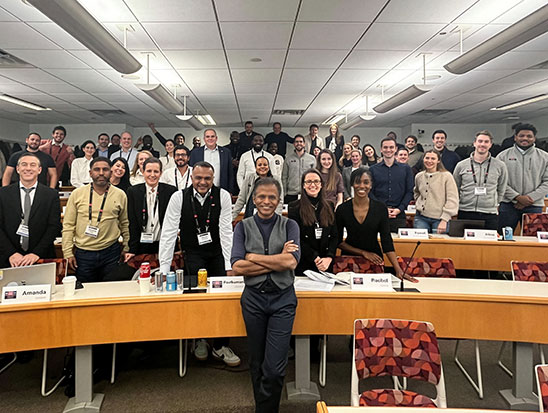
The Class with Professor Damodaran
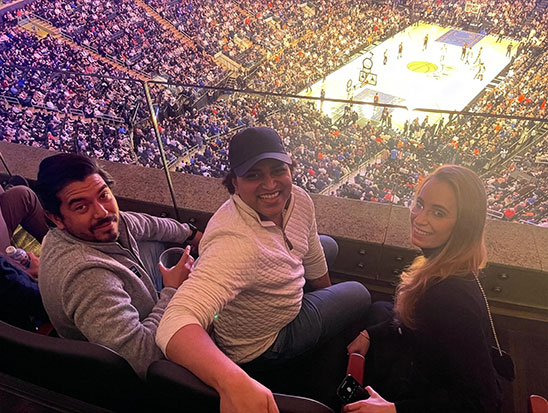
Class members at New York Knicks at Madison Square Garden
And as always, the New York experience went well beyond the classroom. From the New York Knicks at Madison Square Garden to an evening at the Metropolitan Opera, the cohort found time for the kind of shared experiences that sit alongside the academic side of the program, and matter just as much. Careers shift through academic and peer learning, but it is often the moments outside the classroom that turn a cohort into a community.
Halfway through TRIUM, I’m struck by how formative this journey has been, not only because of the faculty across our three schools, but equally because of the cohort itself. The richness of classroom discussion, where we challenge and learn from one another as much as from our professors, has been the most rewarding part of the experience so far.” – Andrea Bruhin
Paris in April 2026
Fast forward to April 2026. With the snow of New York behind them and two modules’ worth of learning already being tested in real roles, the cohort arrived in Paris at the midpoint of the TRIUM journey. Paris began in quintessential French fashion, with a sunset boat tour down the Seine and a chance to take stock before the week gathered pace again.
HEC Paris, widely recognised for its work in strategy and entrepreneurship, shifted the focus to how organizations stay competitive when the market is moving. Under the academic direction of Laurence Lehmann-Ortega, the class worked through business model innovation and the uncomfortable questions many leaders face: when to build on what is working, and when to disrupt it before the market does it for you. From there, the conversation moved into growth strategy and M&A, starting with the ‘why’ before getting anywhere near the ‘how’. An alumni panel brought real deal experience into the classroom, sharing what goes wrong in practice and where leaders tend to underestimate the work that comes after the announcement. The important link between academic content and real-world exposure carried through the week, including a visit to Kering (owner of Gucci, Saint Laurent, Balenciaga) to hear directly about strategic direction and how M&A plays out inside a global group.
The cohort of course made time for activities outside the classroom, from watching PSG at the Parc des Princes to joining the 25th anniversary celebration in Paris. With alumni from across 20 cohorts in the room, it was a reminder that the TRIUM story doesn’t end at graduation, and that many of the connections and conversations continue to evolve long after the program.
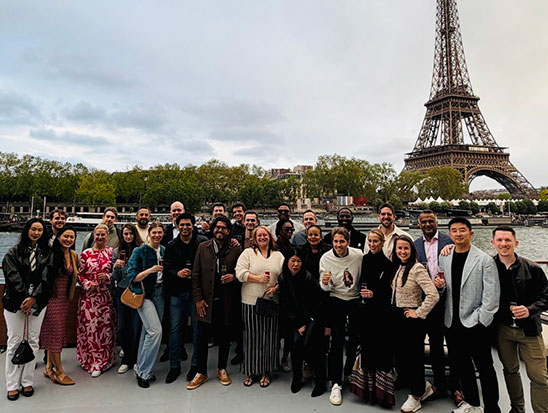
The Class in Paris
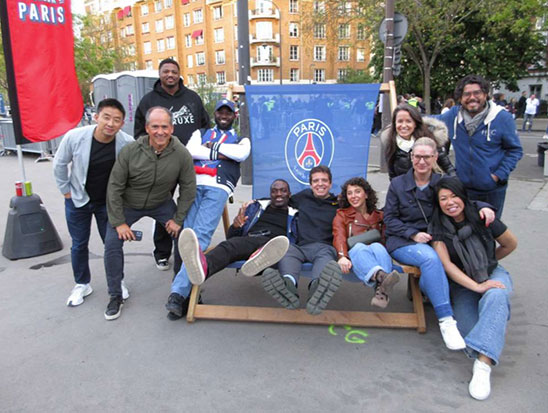
On the way to watch Paris St Germain
With the home modules now complete, the program moves into the future-focused away modules. Next stop is Seoul in July, where the class will step into one of the world’s leading tech hubs and see how that ecosystem operates up close.
What has made it truly special, though, is the cohort. I’ve learned as much from the people as from the program—through shared experiences, diverse viewpoints, and a genuine willingness to challenge and support one another. More than anything, it’s the conversations—inside and outside the classroom—that have shifted my perspective. They’ve pushed me to rethink not just strategy, but how I listen, engage, and make decisions under uncertainty.” – Piyush
One of the most valuable aspects of TRIUM has been the mirror it holds up to you when you are surrounded by highly accomplished leaders from different sectors and geographies. It has made me reflect more carefully on where my strengths genuinely help me and where, if overused, they can become constraints.” – Pretar