





Back to all videos
TRIUM 25th Anniversary Symposium Session Highlights
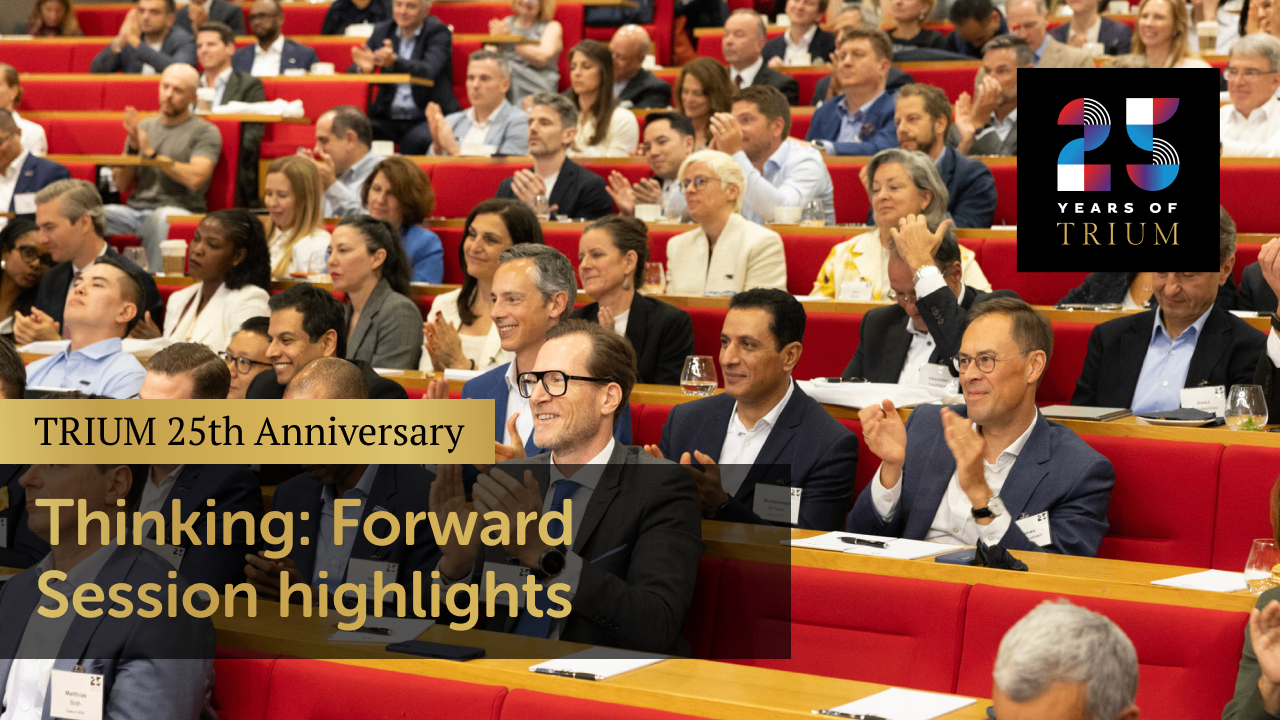
On 4 September 2026, the global TRIUM community gathered in London to mark a milestone anniversary. Alumni and guests explored AI and innovation, business leadership and geopolitics through keynote conversations and panel discussions. Watch highlights from the day for a taste of the speakers, insights and thought-provoking discussions that brought our community together.
In this video:
- Experience highlights from TRIUM’s 25th Anniversary Thinking: Forward event in London.
- Hear insights from keynote speakers and panel discussions on AI, innovation, business leadership and geopolitics.
- Discover some of the ideas and perspectives shaping the future of global business.
- See the TRIUM community come together to celebrate 25 years of leadership and lifelong connections.
Speakers:
- Andrew Bailey — Governor, Bank of England
- Benedetto Vigna — CEO, Ferrari
- The Rt Hon Baroness Catherine Ashton of Upholland LG GCMG — Member of the House of Lords; former EU High Representative for Foreign Affairs and Security Policy and Vice-President of the European Commission
- Jean-Paul Agon — Chairman, L’Oréal
- Dr Leslie Vinjamuri — President and CEO, Chicago Council on Global Affairs
- Professor Larry Kramer — President and Vice Chancellor, LSE
- Professor Eloïc Peyrache — Dean, HEC Paris
- Professor Bharat N. Anand — Dean, NYU Stern
- Professor Michael Cox — Emeritus Professor of International Relations, LSE
- Professor Youngjin Yoo — Professor of Information Systems and Innovation, LSE
Full transcript
We’re really delighted to have you all here from literally every corner of the world, to celebrate TRIUM’s 25th anniversary.
In this room, there are people who have shaped the last 20 years of my life personally and professionally. That is very unique.
So our role is not only to understand the world’s greatest challenges, it is to convene the people who can solve them.
I think that that was the first inkling I had, that this is potentially something really special.
Even if many companies step back from the commitments, we hold ours even more firmly.
How do you address those challenges, those technologies, and how do you make sure that or how do you try to understand which one are more hypes and which one will really lead to deep technological transformations?
If you’re a company entering a new market, you need to deal with questions of political risk and social trust.
Your compute can find cure for cancers, and we are using the tokens to reorganize our
PowerPoint deck to draft our email replies, and they do not generate real value.
You have to cultivate the cultural aspect of what I call the healthy discomfort.
And for me to continuously realize that there is always an evolving answer.
And I think the future is extremely uncertain and to be determined. That’s how a lot of Europeans think about it. How does this work from an American perspective?
But if we do it right, I think we’re going to have the biggest productivity gain and prosperity in recent history.
Problems start somewhere. They don’t stay there. They move. If you don’t deal with issues early on, they end up being bigger issues that cost you more later on.
The same kind of event we do for our client, we do for our supplier, because the message is that what we can do for the client is possible thanks also to the suppliers.
So which industry will be really affected in the long term by the use of AI?
World economy is still functioning more or less. Institutions are functioning still more or less. And by the way, democracies are functioning more or less.
And to do that, they have to embody an understanding about how authority should be
exercised, how conflicts should be managed, how common interests should be protected.
This is fundamentally a management problem as opposed to a technology problem.
Can we collaborate between state government, international organizations to improve and to foster effective global governance? I think one of the challenges is that people tend to think local, and that local is not connected to global, and it is.
It’s a very simple question to ask, which is how can we win? It’s a very, very hard question to answer. And and what we are trying to do is just take the time to think about what are the enduring principles we can anchor around five years from now.