




Back to Alumni
Class of 2024
From Classmates to Co-Founders: Building the Future of Space Education
Inspired to Build for the Next Generation
Every startup has a founding story. Ours starts with a personality test, where we ranked on opposite ends of the spectrum on multiple dimensions of the Hogan Assessment. Statistically, we probably shouldn’t have started a company together. Fortunately, startups aren’t built on statistics.
Most founders say they “complement each other.” We have data to prove we couldn’t have been more different. In reality, those differences became our biggest strength. They shaped WhyCosmos—Asia’s first integrated space education platform dedicated to Astronomy, Aviation, and Space Engineering.
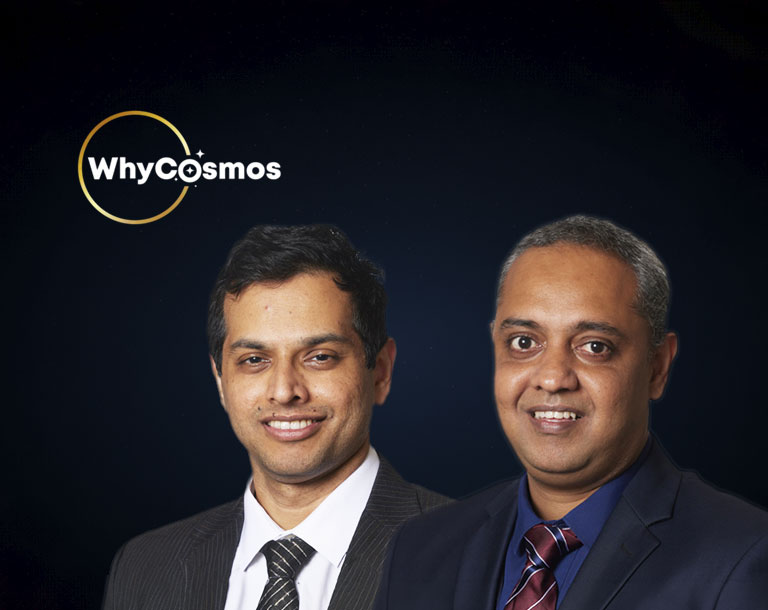
WhyCosmos was founded out of a lifelong fascination with astronomy, aviation and space science. After careers spanning multiple technology sectors and multinational organisations across different continents, we—Arun Reddy and Dhruba Chakrabarti (Class of 2024)—knew that if we were ever going to build a business, it needed to be rooted in a genuine passion. The timing could not have been better. As India’s space sector continues to grow, fuelled by national ambition and a new generation of private space companies, the need to inspire future scientists and engineers has never been greater. Yet despite this momentum, meaningful space education remains largely absent from most school curricula.
These are subjects that fascinated both of us from an early age.
We were also inspired by our TRIUM cohort—some already running successful companies, others launching ventures of their own. We joined the programme to learn and to meaningfully shift our career trajectories and building something we both cared about.”
From Classroom Conversations to Space Missions
The idea took shape towards the end of our TRIUM programme, as we were exploring several potential ventures—one of which evolved into WhyCosmos. To test its viability, we ran some initial market research, and the response genuinely surprised us. Parents were enthusiastic from the outset, and when we spoke to schools, they readily acknowledged the very gap in their curriculum we had suspected was there. That validation was the moment it stopped being an idea and started becoming a business.
We started WhyCosmos to bridge that gap. Our mission is to make space education practical, continuous, and accessible—giving students the chance to observe the night sky, collaborate with peers around the world, build engineering projects, work with professional-grade equipment and teachers, and eventually run experiments on real satellites through our technology partners.
One of the most rewarding parts of the TRIUM journey was the support we received from our cohort and the wider alumni community. Their questions, feedback, and encouragement helped shape WhyCosmos in its early days. We were especially grateful when Jacek Poplawski (Class 2026),Miroslaw Poplawski (Class 2014) and Manoj Kumar (Class of 2026) chose to back our journey and become our first angel investors. Their belief in us provided both the capital and the confidence to pursue our vision with conviction.
Our long-term vision rests on a simple belief: the next generation of scientists, engineers, and entrepreneurs won’t be inspired by reading about space—they’ll be inspired by participation.”
Building a Global Space Education Ecosystem
We officially launched WhyCosmos in March 2025. After building out the platform and core infrastructure, we won our first paying customers within three months of our product going live. We now serve customers across multiple countries in Asia, though we’re still very much in the early stages of scaling.
We operate two models: a direct-to-consumer offering, where students learn online with a teacher over live sessions, and annual school partnerships, where a teacher delivers our curriculum in the classroom in person.
Like many early-stage ventures, scaling has brought its challenges. Recruiting talented individuals who combine technical expertise with genuine enthusiasm for the subject matter remains difficult. Equally challenging has been introducing schools to a new category of educational offering. While robotics, coding and AI programmes are now commonplace, an in-depth astronomy and space engineering curriculum is still unfamiliar in many markets. As a result, WhyCosmos is not only selling a product—it is helping to create an entirely new category of learning.
A Truly Global Mindset – The TRIUM Factor
The TRIUM Global Executive MBA challenged many of our assumptions about WhyCosmos. Exposure to world-class faculty, a diverse cohort, and genuinely global perspectives helped us evolve the company from a collection of educational programmes into a scalable space education ecosystem.”
The programme pushed us to think beyond curriculum and focus on building infrastructure—technology, partnerships, physical labs, and real space missions—that could be deployed across schools worldwide. Just as importantly, it gave us the confidence to build WhyCosmos with global ambitions from the outset, rather than treating it as an India-only business.
As a technology startup, we found relevance in the courses taught during our San Francisco and New York modules. Prof. Jihoon Rim’s and Prof. Sonia Marciano’s lectures offered significant lessons on growing a company from an initial idea and on the concept of business moats, while Prof. Aswath Damodaran reframed valuation for us as being equal parts storytelling and a mathematical exercise.
The most directly applicable framework, though, came from our Capstone project and the Hogan Assessment exercise in our final module in Dubai. Both underscored the importance of diversity of thought and complementary skillsets in a founding team. One of us is naturally outward-facing—selling, partnering, energised by people—while the other is happiest deep in technology. That let us divide the founding work along a natural seam rather than competing for the same ground. Eighteen months on, they’re still the reason we continue to build effectively together.
Between us, we have lived and worked across seven countries on four continents, so we came in believing we already had a reasonable grasp of global business. What TRIUM added was something different: sustained exposure to regions, industries, and individuals we would never otherwise have encountered.
The cohort itself was the real education. Getting to understand what made each person successful in their own field—their instincts, their appetite for risk, the way they made decisions—gave us a broader playbook to draw on. We’ve carried a good deal of that, particularly a greater willingness to take considered risks, directly into how we build WhyCosmos.
What does success look like for WhyCosmos
In five years, our ambition is for WhyCosmos to be a world-leading space education ecosystem—connecting schools, students, and educators to real space missions through a single platform that makes Astronomy, Aviation, and Space Engineering accessible anywhere in the world.
Concretely, that means a student in a classroom in Mumbai, Lagos, or Jakarta being able to observe the night sky, collaborate with peers on another continent, and run an experiment on an orbiting satellite—all as a normal part of their education, not a rare privilege. If we get there, we won’t just have taught space; we’ll have helped build the generation that goes on to work in it.
The Lasting Value of the TRIUM Network
Reflecting on our TRIUM experience, we feel that some of the programme’s greatest benefits happened outside the classroom.
Make friends. Attend every class, of course—but don’t skip the after-class dinners and the drinks that follow. The lectures will make you a better leader; the conversations outside the classroom will give you lifelong friends, trusted advisors, and perspectives you’ll carry long after TRIUM.
It sounds like a cliché to say you’ll make friends for life during the programme—but every cohort is so diverse, geographically and professionally, that these relationships become something more than friendships. They turn into a global network you can call on for advice, candour, and opportunity for decades. Our own advice is simple: invest in the people as seriously as you invest in the coursework. The return compounds long after graduation.